Showing posts with label Geological Metaphors. Show all posts

Sunday, March 02, 2008

Poets from the Volcano


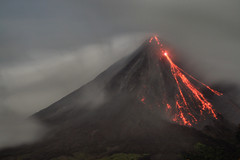
Arenal
Originally uploaded by Clearly Ambiguous.


The 20th Century poet René Char made no secret of his admiration for his long-dead 19th Century predecessor, the young French poetic genius Arthur Rimbaud who completed his entire oeuvre before the age of twenty-one, then left France on a series of adventurous engagements in far-flung parts of the world, travelling as far as Java in the pay of the Dutch Colonial Army and working as a merchant in Ethiopia.

Char admired Rimbaud's decision to leave Paris. In his poem: "Tu as bien fait de partir, Arthur Rimbaud. (You did well to leave, Arthur Rimbaud)", he writes of Rimbaud the outsider, Rimbaud who "abandoned the streets of idlers, the taverns of lyric-pissers." He asks: "Si les volcans changent peu de place, leur lave parcourt le grand vide du monde et lui apporte des vertus qui chantent dans ses plaies. (If volcanos barely move, their lava travels the great emptiness of the world and bring to it the virtues that sing in its wounds.)"

In this metaphor, we see Rimbaud going out into the world as a stream of lava, bursting from a volcano, scorching the ground over which it travels. There is the sense of the departing lava creating a wound in the volcano, but also the idea of these wounds being worthwhile, becoming virtuous as the poems left behind in them begin to sing. The volcano is at once the city of Paris, but also the sum of French culture at the time: something static, that barely stirs.

In another poem, Char addresses a different voyaging hero Antonin Artaud as follows: "Je n'ai pas de voix pour faire ton éloge, grand frère. (I don't have the voice to praise you, great brother." The poem seems to have an elegaic theme, but at the same time revolts at such a concept as elegy and, speaking of Artaud, states: "Pour nous, rien n'est changé, / Rien, sinon cette chimère bien en vie de l'enfer qui prend congé de notre angoisse. (For us, nothing has changed, / Nothing, if not this lusty chimera out of hell which from our anguish takes its leave.)"

Earlier in the poem, Char speaks of "a heart shared by us" that "kills, goes hollow and burns, / Then is reborn in the softness of the mushroom" and of "lightly chopping down a forest / With our entrails for an axe". As in the earlier poem to Rimbaud, there is a creative confusion between inner and outer spaces, the poet a phoenix-like force capable of devastating the physical world, but containing the idea that this devastation is really internal, and associated with the poet's own demise, the spilling of his own entrails.

Then Char commands Artaud to return to the same place from whence Rimbaud emerged: "Il suffit. Rentre au volcan. (It suffices. Go back into the volcano.)" In so doing, he writes a kind of formula for his ideal poetic character: eruptive, wounding and feverish.

The title of Char's most famous book "Fureur et mystère (Fury and Mystery)" might even have been made to describe volcanos which are always a source of fear for those who live near them and of mystery for those who try to understand them. And might not these features be also what Char admired in his "great brothers"?

Thursday, September 20, 2007

Tectonism


Tectonics
Originally uploaded by JW.

La première fois que je visitai ce site singulier (le Salève in the Alps), j'éprouvai une espèce de saisissement dont il eût été difficile de se défendre. J'étais seul et fort jeune, peu accoutumé à ce genre de spectacle; ces rochers escarpés, ces fragments entassés réveillaient des idées de dévastation et de ruine.

H.B. de Saussure, author of 'Voyages dans les Alpes' (pub. 1779-1796).

When I look at the Alps, I see the result of a great collision between huge plates of rock floating on the face of a molten earth. I see the result of a collision that uprooted long-buried sediment and forced it, mechanically, foot by foot, upwards into the sky. Slabs of rocks compressed lengthways, shortened by all kinds of different means including bending, shearing, slicing and even cutting and stacking. In fact, most commonly by cutting and stacking, like a Monte Carlo card table dealer shortening a splay of cards back into a pack.

It is miraculous to imagine the forces that have shifted these immeasurably large pieces of the earth towards the heavens so that now clouds can wrap themselves around the summits, caressing the bare rock and the fossils of bivalves within them, feeling the striations on the shell of a creature that lived more than one hundred million years ago. Gravity that holds humans down to the face of the earth is as nothing to the forces the raised these mountains. Only time and the gentle, insidious erosion of the wind and rain is able to withstand and act against them.

And in the Alps, I see something else, a visual metaphor for something which is difficult to appreciate in human terms. I am thinking of the cultural damage caused by the collision of human civilizations: the breakage, folding, distortion of cultures which results from the pressure, the collisions of war.

In the great crumbling edifice of the Alps, the piled up pages of history now mashed and crumpled, the steady accumulation of history as dirt, scooped up and shunted by a tractor bulldozer, I see the displaced, the dead, the great mass of terminated human histories implied by war, impossible to regain.

How am I, not affected immediately by war, not able to live through it and survive, only dimly influenced by its outermost ripples, as the coastline of Scotland bears the weakest traces of the Alpine compression - how am I, sitting here, far from that collision of war, to imagine what war really means?

How am I to imagine, here in the comfort of my home, with my censored television screen, with my impersonal and unconcerned newsapapers, what war ultimately means? I cannot.

But when I look at the Alps, their shattered internal beauty of stratigraphic forms, a million datelines recording the passing of comets and a trillion tides, in these boney and jagged mountains caressed by grey, wispy clouds, I can see what war means.

Sunday, April 15, 2007

The Present as a Coral Island...


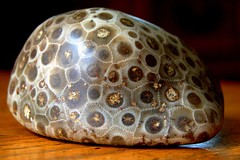
Polished Petoskey
Originally uploaded by {D}.

One of the reasons I haven't posted much recently is that I've been reading about early medieval French history. It's not my usual sort of reading matter but I've been quite hooked firstly by a book that was pressed into my hands by a friend: Michael Crichton's 'Timeline' and secondly by an excellent historical biography of Eleanor of Aquitaine by Alison Weir.

My friend insisited that I read Crichton's 'Timeline' because he knew that I enjoy visiting the Dordogne region of France, which is where the novel is set. The story imagines that an American hi-tech company discovers how to transport people back through time and that they test the procedure on several archaeologists, transporting them back in time to see the real world they are currently digging up in the south of France.

The four pages of bibliography at the end of the book suggest that Crichton has done some research both into the quantum physical possibilities of time travel and into the details of life in the 14th Century: books about medieval cooking and medieval prostitution among the many listed. He does do quite a good job of bringing the period to life through his descriptions and by gauging the reactions of his university-educated archaeologists when faced with the reality of taking part in jousting competitions, cutting the heads off angry medieval soldiers etc. etc.

What merits a mention on Connaissances is the French theme, of course, and a geological metaphor (the only metaphor in the book as far as I recall) which comes from the mouth of Crichton's baddy: Doniger, a man who has lost sight of moral values in his greedy application of high technology.

Doniger was walking around his office, mouthing the words to his speech... using Kramer as an audience of one. "We are all ruled by the past, although no one understands it. No one recognises the power of the past," he said, with a sweep of his hand.

"But if you think about it, the past has always been more important than the present. The present is like a coral island that sticks above the water, but is built upon millions of dead corals under the surface, that no one sees. In the same way, our everyday world is built upon millions and millions of events and decisions that occurred in the past. And what we add in the present is trivial.

"A teenager has breakfast, then goes to the store to buy the latest CD of a new band. The kid thinks he lives in a modern moment. But who has defined what a 'band' is? Who defined a 'store'. Who defined a 'teenager'? Or 'breakfast'? To say nothing of all the rest, the kid's entire social setting - family, school, clothing, transportation and government.

"None of this has been decided in the present. Most of it was decided hundreds of years ago. Five hundred years, a thousand years. This kid is sitting on top of a mountain that is the past. And he never notices it. He is ruled by what he never sees, never thinks about, doesn't know. It is a form of coercion that is accepted without question. The same kid is skeptical of other forms of control - parental restrictions, commercial messages, government laws. But the invisible rule of the past, which decides nearly everything in his life, goes unquestioned...


(The photograph of a polished coral fossil at the top of the page is by {D} on flickr. Petoskey stones are the state stones of Michigan where they can be found. The coral fossils they contain are Devonian age, around 350 million years old. The stone is named after an Ottawa Indian Chief, Chief Pet-O-Sega whose name means "rays of dawn".)

Saturday, April 07, 2007

Rivers Living and Buried

Joe Milutis' recent posts on Impossible Object discuss Part III of Book 3 of 'Paterson', William Carlos Williams long poem sequence of which Book 3 was first published in 1949. One of Joe's posts is an interview with poet Lytle Shaw who refers to the lithological column description in this section of Paterson, interpreting it as a metaphor for America's underlying cultural heterogeneity.

In my view, the lithological column relates quite closely to the poetry that surrounds it. Although Williams doesn't say it, the rocks that are being described are fluvial in origin. We know this by their red colour and lithologies and by the reference to "rock salt of England" which is Triassic in age: a period when alternating deserts and flash flood rivers were the norm.

The sections surrounding the lithological list contains plenty of references to rivers and I think Williams is thinking about how the 'leaping stream' in which fish are 'full speed stationary' and railroad embankments are undermined becomes something leaving a layer of mud ("if only it were fertile"). This allows him to contemplate how the rushing present relates to what will one day remain of us: "the past above, the future below and the present pouring down - the roar, the roar of the present..."

One part of the poem tumbles down the page like sediment settling out of suspension. This makes the link between sediment and language a physical one and I think that is present too in the last verses: "I must find my meaning and lay it, white, beside the sliding water: myself - comb out the language."

Williams also writes of how shells in the river are 'baked by endless dessications into a shelly rime' making a pun on sedimentation and poetry but also using the process of dessication and condensation as a metaphor for the making of verse.

There are other themes as well to do with fertility and death (the river carrying a dead dog) which make me think of the Ganges and Hindu mythology.