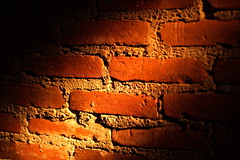
Bricks
Originally uploaded by Esparta.
Last week I was invited to our neighbour's house to participate in a "soiree de conversation anglais". Each member of the group prepares a short recitation in English on a set subject. The contributions are generally humorous and eccentric explorations of an alien language. This week the subject was 'Hot and Cold'. We learnt that a 'hot seat' in America is an electric chair and pondered the origin of 'cold turkey', wondering if perhaps the phrase 'cold chicken' might be used to describe the enforced deprivation of minor drugs such as caffeine. After a dose of language, the evening moved on to a pot-luck supper - which turned out to be very pot-luck: black pudding, onion quiche and seven different desserts...
Our neighbours, both members of the group, have lived in their house for more than thirty years. The husband is an architect who designed the house in the 1970s. It is semi-detached, originally built as an experiment in communal living with his neighbour (not us, the other one). The interior design is open plan with upper and lower level connected to form a large open space in the living area. Our neighbours love to travel and have many souveniers of visits to Africa. The book case is also quite fascinating and I sometimes glance surreptitiously at it when I visit.
On this latest occasion, I noticed a copy of Ferdinand de Saussure's 'Cours de linguistique générale', a large, daunting-looking book with a bright orange cover. I asked if I could have a look at it and immediately noticed that it had been read and analysed in some detail with pencil jottings in the margin. When I asked about this, our friend explained that it had been one of the basic texts that had informed his architectural thesis, an analysis of the signification of bricks.
I have borrowed this thesis, written in 1978, and have it in front of me now. The introduction outlines the scope of the study: "We have tried a different approach to the problem (of the signification of architecture). If architecture - a social product - can be a bearer of signs, it is not architecture itself which should be interpreted, but the conditions which produce it... but the subject is too vast, and we must find a narrower point of focus. The brick is the first achieved element in the history of architecture of which a trace can be found..."
The thesis charts the use of brick from the moment 9000 years ago when, with the cultivation of wheat, mediterranean peoples began a sedentary lifestyle and began to invest their energy in the building of permanent homes using brick. They discuss the first brick to have been discovered from archaeological investigations, which comes from Jericho and was made around the 8th millenium. The clay in this area, a powdery aeolian silt containing a strong proportion of lime creates a maleable mixture which is extremely strong when it dries. For the authors, the finger prints made along the top of these bricks, evokes a loaf of bread.
They trace the importance of brick in the building of the earliest great civilisations of Sumeria and Mesopotamia. The god of brick was called Kulla, created from a pinch of clay drawn from the Apson, the "primordial river". "The brick is the symbol of the man fixed in his home, with security and divine protection; but also of limit: of rules, of measure. The closed society as opposed to the open society of the nomad." The development of the oven-baked brick facilitated, according to the authors, a social stratification of society with these better quality bricks being used for palaces and official buildings. Eventually, among the Babylonians, the oven-baked bricks of palaces began to be marked with the seal of the god-king.
The Romans were responsible for propagating brick-making technology throughout their empire, and hence into all parts of Europe. Through the next centuries, however, it was generally the regions that lacked building stone which turned to brick as a building material. This meant that certain regions of Europe became strongly identified with brick built buildings, others not. In Tudor Britain, however, the use of brick became fashioanble since it was associated with the cnstruction of royal palaces, even to the extent that, in regions where stone was common, brick remained the preferred building material among the nobility. In regions where stone was not present, itinerant brick-makers would construct houses from bricks made of clay extracted from a pit that eventually became the house's own cellar.
By 1820, in a world of economic liberalism and inexistant work laws, whole families would manufacture tonnes of brick during 16 hour work days. The quality of the bricks was better when worked by hand, moulding the clay with sand scattered on the work bench in the same manner that a baker would kneed bread on a bench scattered with flour, to stop the dough from sticking. From around this date, the hand-process was replaced little-by-little by machines which accelerated the brick-making process, while replicating the traditional mixing and moulding manipulations of the hand process.
Industrialisation, and the seach for materials which would allow the bricks to bake more quickly - thereby saving energy costs, degraded the quality of bricks and gave them the reputation of a cheap material. In Britain, the 'Fletton Brick' quarried from the Lower Oxford Clay near Peterborough, was found to use 65% less energy to bake than other bricks and gave rise to the London Brick Company, a business so successful that its economical product was able to fight off all competition and hence provide a distinctive face to much British architecture.
Industrialisation also led to innovation in brick production, notably in the creation of perforated bricks of different size and shape with a variety of surface textures. This in turn led to a technicialisation of what had always been a relatively simple process: the building of a wall. Now different kinds of brick were required to provide strength, ventilation, insulation etc.
In opposition to this specialism, at the close of the 20th Century, brick-makers were also returning to traditional methods of brick-creation. Such bricks were expensive and were used in a distinctly different manner than the traditional, as decorative gables and entrance decorations, their presence symbolic of a 'lost paradise'.
All of this historical evolution has left the brick with a very varied image and symbolic significance which is then taken up in the second part of the thesis by an analysis of the associative and significatory aspects of brick (to be continued...)