Showing posts with label French Particularities. Show all posts

Saturday, April 12, 2008

French Particularities No. 17: Les Chaises


Between rides, Les Chaises is still for several minutes as people climb up onto the platform and choose their chair. The platform is like a stage, and they are the performers, lost, looking for the seat with their name on it. It's a relief to sit down, and when they do, they're suddenly a member of the audience, waiting for the show to start.

There are two kinds of chair: twin seats and single seats. Small boys and girls like to sit together on the twin seats. Adults prefer the single seats, large men glancing uneasily up into the steel rigging of the chair some twenty feet up where they see a steel bar that looks like a specially adapted coat-hanger strung with two light, whippy chains.

Teenage girls have been on Les Chaises many times before and have grown cocksure. They twist the chair so that the chains wind up like a rubber band, until eventually they are standing on tip-toes with the chains wound into a tight braid above their heads. When Les Chaises starts to move, they are whipped off their feet and start to spin chaotically, madly. They let out screams that mingle with the fake-happy organ music that has started to seep out from inside the central pillar.

The transformation from static to dynamic is brutal and graceful all at once. The chairs rise up into the air like enchanted furniture. Suddenly the riders are silouhetted against the sky, hair-flying, arms and legs outspread. Against gravity they rise and fall as the great mexican hat of Les Chaises nods like a drunken hombre on a long summer afternoon. It is a dream, they are the black albatrosses swarming before his eyes, looking for a tree to perch in the middle of the ocean. The branches grab at their ankles, the music grows cold. The heavy men feel gravity pulling at their legs. The young women grasp their bosoms.

Each tries not to slip forward on their seat, gripping the silver handles of the chair or the arm of a companion. Some imagine flying, others falling. Some think of the moon, others try to spot the faces of their mothers, fathers, blurred on the ground below, quick flashes of a past life suddenly transformed by perspective.

The heaving machine begins to slow, the chairs start to descend. Everyone has survived. The riders leave their places, say goodbye to the stage. There was never any risk, was there? The great hidden machine has let them fly, giddily, fatherly. They trusted it, the painted panels, the naked ladies at their bath, the Fragonard madamoiselles swinging in forest glades, the muscle-thick ropes supporting all their blustering silk and lace, their pale pink shoes taking flight.

Sunday, March 16, 2008

French Particularities No. 16: Cash on the Table


Here are a few 'astuces' concerning the cash in your pocket translated from L'Itinérant, a magazine sold by the Parisian homeless for a cover price of 2 Euros.

In France, shopkeepers can refuse payments of more than 50 coins. If you have six hundred 5 Euro banknotes, you can spend them all at once, but no more than that since payments in cash of more than 3000 Euros are outlawed in France. Infringement can result in a fine of 15000 Euros to be shared between buyer and seller. Business transactions in cash must not exceed 1100 Euros.

Refusal to accept a payment in cash can result in a fine of 150 Euros. However, if you offer a 10 Euro note for a baguette, the boulanger has the right to refuse it. If the boulanger thinks you have given him a fake banknote, he has the right to ask for your identity papers and contact details and later pursue you for making good his loss if the bank note proves fake.

If you are in possession of a fake note, you should take it to the Bank of France where it will be confiscated. You will not be reimboursed, but you will avoid the possibility of a 7500 Euro fine for making a payment with fake money. Franc notes can be changed at the Bank of France until 17 Feb 2012.

If you have a damaged bank note, you can replace it at the Bank of France. If the note is very badly damaged, it may be necessary to analyse the note, in which case you will be charged for the analysis.

From: L'Itinérant (Premier hebdomadaire de lutte contre la misère et la précarité.)

Thursday, September 13, 2007

French Particularities No. 15: Les Taxis


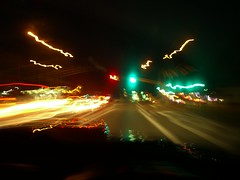
Headlights
Originally uploaded by number8838.


This morning I was up at 4.45 a.m. in order to catch an early flight at Orly Aeroport. The taxi arrived at 5.30 a.m. and somehow I still hadn't managed to summon the energy to shave, despite having got to bed at 10 p.m. the night before. I was too busy eating crunchy muesli and watching John and Nippy launch their Indian restaurant in the South of France using an African elephant they'd rented for publicity purposes. Such is the fare on BBC Prime at 5.10 a.m. on a Thursday morning.

The taxi was not the usual small minibus, but a sleek midnight blue Peugeot of executive saloon proportions. The driver looked around 40 years old, in all but his hair style which cascaded in thick wavy locks over the shoulder and a good way down his back. Orly Aeroport? he asked, and off we went, not another word exchanged throughout the journey.

The car accelerated quietly and efficiently into the dark morning streets and I found myself pinned to the leather seat by a rapidly accumulating G-force. The interior of the car was suffused with a spooky fluorescence from the dashboard dials while from the distributed speakers came an intimidating screech of warped guitars and paranoid human voices. The digital readout on the dash indicated each band and the title of their track. For unknown reason, at the end of each number, spontaneous appreciation broke out, and I found myself wondering why heavy metal fans have a stronger tendance to whistle than to clap.

Today was the 13th of September and as we accelerated down a ramp on to the A13, our bumper expertly positioned three feet behind the bumper of the car in front, the track changed on the MP3 player and I read the name of the band: 'Citizen', and the title of the track: 'Erased'. Like this:

Citizen
ERASED

We surged past the little Citroen that had been delaying us for the previous two seconds and shot like a steel ball-bearing from a Black Window catapult towards Orly Aeroport. Suddenly, I noticed a wierd tapping noise. It seemed to be part of the music in the car, but was somehow of a different timbre. After listening for a minute or so, I realised it was the driver who, far more intent on the music than could be healthy, was playing various bits of the fascia around his seating position with his fingers and thumbs, rapidly tapping out not merely the same beat as the drummer in the band, but a contra puncto which clearly took some concentration. All this while swerving inwards to overtake another 'slow' driver using the fast lane for unnecessary purposes.

We arrived at Orly via a route I had never taken before that proved somewhat more expensive than normal but which had a number of long and exciting bends that kept me jammed to the door of the car for several long seconds at a time. When I got out of the car, I almost forgot my change, so excited with the experience was I...

Saturday, August 18, 2007

French Particularities No. 14: Volets


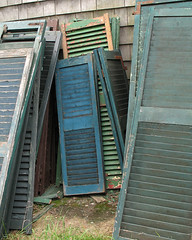
shutters
Originally uploaded by Paul Keleher.


The French word for shutters is 'volets'. Here is what a web site of French words for children to learn says about the word 'volet' (being the typical French word starting with the letter V):

Volet (nm): a shutter; French houses all have shutters for security and insulation purposes as well as esthetic reasons of course.

(To deviate for a moment, the list of 'typical' French word on the web site linked to above is quite an interesting one, including the likes of 'beret', 'escargot' and 'pain'. It reminds us that there are no words of French origin beginning with the letter 'k' or 'w', only words adopted from other languages such as 'weekend' for example, for which there is no French equivalent apart from 'fin de semaine'.)

The word 'volet' might either derive from 'voile' meaning a mask, or from voler which means 'to fly' (referring to the physical appearance of shutters as a pair of wings). Perhaps the origin may have some link to the other meaning of voler which is 'to steal', the volets being a preventative measure against this.

That "of course" in the children's definition is quite intriguing. Why is it "of course" that we should find shutters aesthetically pleasing? I'm not disputing the fact. I remember that about twenty years ago my parents had shutters fixed to the front window of their house. It was not a kind of house that you would particularly associate with having shutters, but the shutters looked okay when they had been afixed and indeed they did improve the appearance of the house, even though they were painted a non-descript fawn-type colour. They had no fancy decoration, they were just a washboard of slats, and yet they worked in their intended aesthetic role. Even though they did not work. They were mear steel plates screwed to the wall, unable to budge an inch...

As far as I'm concerned this is the perfect shutter solution, because shutters are a pain in the proverbial. As the definition above tells us, all houses in France have them for security purposes. This means, in fact, that if a burglar calls, and you are not at home, and your shutters are open, then your insurer will not pay up. Imagine, if you have shutters all over your house, and you want to nip out for a newspaper. You have to go around to every window closing them, catching your fingers on rusting latches, slipping tricky locks into place. And do they even work? I'm sceptical. I don't think ours would last long against an experienced burglar with a good strong jemmy.

Because every house in France has them, and because they are a pain to keep opening and closing, they give the whole country a particular character: a character of being shut up, closed for business. It is possible, at any time of year, to find towns in which whole streets look as if the Black Hand Gang just rode in. Streets in which every house appears to be asleep, threatening you silently not to even think about ringing the bell. And yet there will be life inside. Life that has forgotten about the need for daylight and contents itself with the mumbling of the TV and the sound of children squabbling.

Don't be misled by the comment about insulation. I don't think shutters are really able to keep your house warm. They are mainly effective in keeping a house cool in the summer by blocking direct sunlight from entering. Useful during a canicule summer (French heat waves are called canicules), but not much help during this year's dreary August weather.

So what is it that is so aesthetically pleasing about a few slats? Is it just the power of association with Mediterranean Europe? It's true that green or blue shutters are pleasing to the eye, but even my parents' fawn shutters were okay, so I have a tendency to believe that it is perhaps something anthropomorpic. Something about not having a gaping hole on the front of your house with nothing around it. Something about needing a frame, as a face benefits from being framed by locks of hair, or as eyes need eyelashes and eyebrows around them to provide character (and not to keep off the poisonous droppings of birds, as one of Nabokov's characters would have it).

This year we went away on holiday to Italy. We had a hotel room with plate glass windows looking out at the Dolomite mountains. It made a nice change from the farm house in the Dordogne we usually rent, which is perfect apart from one thing: about twenty sets of shutters.

Thursday, May 24, 2007

French Particularities No. 13: Presidential Amnesty


One French particularity which it seems to me is particularly French, is the fact that, when a new president gets into office, it is widely expected that he (or she, ho hum) will give an amnesty to all automobile offences that are in the pipeline for prosecution.

French drivers are a pretty dangerous bunch in general. It is something I have written about at length here. Many drivers do not seem to want to admit to themselves the real function of a zebra crossing. 87% of pedestrians in France say they have often or sometimes difficulty crossing the road.

Only yesterday, my wife was about to cross a zebra just outside my daughter's school when a car went sailing past right in front of them. Furious, my wife slammed her bag against the back of the car, realising shortly afterwards, when the car pulled up, that it was none other than a mother of another child at the school. When my wife confronted her she explained her action by saying: "I thought you were talking to your child." My wife riposted: "Yes, I was telling her how to cross the road safely." Which was no lie.

20 Minutes magazine this morning stated that: "there has been an almost constant increase in the number of deaths on the roads in France since December 2006." The number of deaths are up 8%, the number of injured by almost 14% and the total number of accidents by 10%.

Pierre Gustin, Délégué général de la Prévention routière, says: "these very upsetting statistics are above all due to the relaxation and loss of vigilance shown by drivers in the light of a possible amnesty. We are for the complete abolition of this amnesty. It is a medieval system that is completely unsupportable. France is the only country in Europe where this still exists."

In fact, Nicolas Sarkozy was very clear during his presidential campaign, saying: "there will be no question of an amnesty for traffic infringements". Today, the Elysée Palace confirmed to 20 Minutes: "Not even an amnesty for parking infringements."

This then, is one more break with the past. In 2002, Jacques Chirac gave an amnesty to all non-endangering parking offences.

It has also been announced that the panels which forewarn the position of speeding cameras (a development of only the last few years in France) are going to be removed. Thousands of taxi drivers all over France are going to go into immediate bankruptcy.

This is all good news. And what is also good news is that since 2002, when a major effort was launched to improve French road safety, the number of road deaths have decreased by 43% overall.

Friday, February 16, 2007

French Particularities No. 12: Les SDFs

When I was a student at the University of London in the 1980s, there seemed to be homeless people everywhere, begging for change, many of them living in cardboard boxes under bridges by the Thames. It seemed that the problem was part and parcel of Margaret Thatcher's new, low tax, unregulated, service-driven economy. House-prices in London had shot up rapidly and this had no doubt acted to squeeze out those at the bottom end of the housing market onto the streets.

It would seem that the same thing has happened in Paris over the last few years, housing prices (always judged by the square metre in Paris) having doubled between 2000 and 2006. Today, Paris appears to have a chronic homelessness problem. Some regular readers will remember my post here just before Christmas about the death of a homeless person who lived in the foyer of the building where I work. Two months later his 'patch' is now occupied by two homeless men, one quite old and feeble, the other younger and black.

On Wednesday I went out for the evening in Paris. I felt as if I was seeing homeless people everywhere. I suppose I must have noticed between twenty and thirty, sleeping rough in the metro or riding the trains. One couple settled close to me on a busy RER train as I headed for home. They were a man and woman, both around thirty. The woman's gentle face was terribly puffed up and bruised as if she had been severly beaten up, her mouth distorted strangely. The man, who was bearded, watched her attentively. When she crouched down in a corner of the carriage and tried to sleep with her head on her arm, he crouched down beside her and supported her. All they had was a carrier bag each. On the arm of the man's shabby grey anorak was a sewn label which read simply: STATUS. Huddled together they reminded me of Toulouse-Lautrec's beautiful picture the bed, only that they were living out this tender partnership on a crowded train, some of the passengers looking on with notable looks of distaste.

These people are known as Les SDFs, les sans domicile fixe (no fixed abode). Their average life expectancy on the streets is 48 years of age. Two-thirds of them are said to have some kind of mental illness. Over the last few months, various groups have been trying to generate the political will to do something about the problem. A group called Les Enfants de Don Quichotte has set up two hundred red tents beside the Canal St Martin, partly as temporary accommodation for certain SDF and partly as a protest against the problem.

Almost 20,000 people have so far signed up to the charter that 'Les Enfants de Don Quichotte' have asked public and politicians alike to sign. This may seem like a lot, but rather shockingly, it means that only 3400 people in Paris are sufficiently concerned to sign up, despite quite a lot of media attention to the subject. Here is an outline of the charter:

We, citizens, refuse the inhuman situation in which certain of us live without fixed residence. We want to put an end to this scandal, and the shame that it represents to a country like ours. The Constitution guarantees the right to dignity, with suitable means of existence, and we have a duty of assistance to anybody in danger. We will no longer accept that the most fragile or poorest are left at the edge of the road. It is necessary to put an end to provisional solutions, emergency planning which worsens precariousness and condemns so many people to an unbearable suffering, and for some, an untimely death. We ask the State to set up, as of today, an ambitious policy guaranteeing the access of all to real housing, through the following measurements. For the dignity of all.

Article 1: To open the lodging houses 24H/24H, 365 days per annum, and to humanise the conditions of reception.

Article 2: To stop the homeless being sent back to the streets. Every welcome at a lodging house should lead to a stable solution.

Article 3: To create an immediate offer of temporary residence.

Article 4: To create more social housing accessible to the poorest households.

Article 5: To develop accommodation for alternative styles of living, such as communal living.

Article 6: To make the right to a lodging place a legal right in France.


It was fifty years ago that Abbe Pierre's campaigning first made it illegal in France for bailiffs to force lodgers from their homes during the winter months. It would be a fitting memorial to Abbe Pierre, the founder of the Emmaus movement and ardent campaigner for the homeless who died on 22nd January this year, if this charter were put in to action.

Friday, December 01, 2006

French Particularities No. 11: Magic


Magic is taken quite seriously in France. I'm not talking here about TV magicians but, in intellectual circles: the cultural phenomenon, and more widely: superstition and the supernatural.

This is one of the surprising things you notice about French bookshops: they have two sections that are normally very large and which hardly exist at all in the UK. One is the comic book section, the other is the supernatural section. Often, the supernatural section can be vast, stuffed with tomes on astrology and encyclopaedia's of the strange.

Why this interest in the supernatural? Is it a by-product of Roman Cathlocism? Is it because France is a very rural country? I don't know. It may be because rational intellectualism has not outlawed it, as has happened in the UK, but rather 'tunnelled under' to try and understand its meaning and significance.

In other words, rather than surpressing magic, the French try to understand it and integrate it.

I began to understand the intellectual significance given to magic by reading Levi-Strauss and discovering him as a sort of human link in a chain of philosophy which stretches back in time through first Marcel Mauss and then Emile Durkheim.

Mauss wrote books on the importance of the exchange of gifts in society. Like the exchange of stone axes dressed in grass skirts that I described here Essentially, the stone axes are the symbolic representations of the women the men are actually exchanging. Mauss also wrote a 'General Theory of Magic'.

Today I began reading a book about French literature and magic 'from Chateaubriand to Rimbaud'. This is an analysis of intellectual thought about magic and what role magic plays in society. It begins by identifying the origin of the magical impulse in the world of the child. As the newborn child starts to develop, it slowly discovers that by making utterances, it can get what it wants. By crying in the night, its mother will come. By saying 'chocolate' it will get a piece of chocolate. This is the ultimate magic. By making an incantation: 'Chocolate', a piece of chocolate arrives in your mouth. The baby does not discriminate between the word and the thing.

But one day the baby says 'chocolate' and the chocolate does not arrive. The baby says 'mother' and the mother does not arrive. It is at this point of intense disappointment that man's efforts to make magic begin. To return to that state of innocence where what they demanded appeared as if by magic.

There are two ways in which this state can be attained.

The first is for the magician to believe so strongly in his/her ability to make something happen that eventually it does happen. I take this to mean that the magician, through training, becomes capable of performing incredible feats. I guess this might be what you'd call a 'stunt magician', the type who traps himself in a block of ice for weeks.

The second is for the magician to underestimate reality. In this model, the people surrounding the magician subjugate themselves to him/her and fulfill his/her wishes. They cooperate in deceiving the magician that he\she retain the same powers they had when they were a child who didn't understand the difference between the word chocolate and the thing chocolate which doesn't, when you annunciate it, necessarily fly off the table and land in your mouth. I think this is the magican who 'pulls tricks out of a hat'. We know he can't possibly have three rabbits in the hat, but we suspend belief and allow ourselves to be deceived.

In these two models, the roles are reversed: in the first, the audience is deceived (because they really believe it is magic) and the magician is convinced. In the second model, the audience is convinced (into suspending belief) and the magician deceives himself (because his magic, in fact, depends on the goodwill of the audience).

Why bother with this? A rational intellect might simply say that this stuff is nonsense and give it up. This underestimates however the human desire for magic, for what we wish for to come true. If we let it, imagination can be constrained by rationality and by trying to remain true to observed facts. Magic and myth and poetry are what lie outside these observed facts and which depend on the power of the unconscious mind to transform the everyday into something beautiful and strange.

Saturday, January 28, 2006

French Particularities No. 10: School on Saturday

This is one French particularity I could do without. This morning I had to get out of bed at 7.45 to get my daughter to school. Normally, that's okay, but today is a Saturday and, frankly, I need that extra hour or two in bed to recover from the previous week.

Bleary eyed, I have managed to get her dressed, breakfasted and down to the school. She, for her part, is quite happy. She put on her pink school slippers and walked off into the classroom quite happily to pick up a felt tip pen and start drawing on a piece of paper already laid out and waiting for her on the miniature round tables where the children create.

It's only a half day of school and, at the moment, it's only taking place on a few weeks of the term. When she's older, it will be every week, but perhaps by that time we will have decided to put her into the British school...

The inverse of school on Saturday is no school on Wednesday afternoons. For working couples, this means that they have to take half a day off work in order to look after their child, or pay someone else to do it. What the origin or purpose of this scheme is I have no idea. Perhaps if any of my readers know, they could leave a comment. The only thing I can think of is that it gives working women an opportunity to spend Wednesday afternoons away from the office and have some quality time with their children.

The downside is that if your children are in school every Saturday morning, you never get the opportunity to take off on a Friday night in order to visit somewhere for the weekend. Perhaps that's why so many hotels in the countryside shut down from the start of October to the end of March.

Oh well, at least it gives me the opportunity to start working on my Burns speech. Gotta put it together before tonight...

Wednesday, October 19, 2005

French Particularities No. 7: Les 400 Coups


'Les 400 Coups' is one of Truffaut's great films, the history of a young, independent-minded boy who ends up in reform school. I imagine the title is a word play referring not only to the 400 physical and mental 'blows' that the child receives during his troubled life but also to the very common use of the word 'coup' in the formation of French phrases. In fact, it is difficult to separate the two meanings since the 400 blows that the boy suffers would probably each have their own descriptive phrase beginning with the word 'coup'. However, not all of the 'coups' would necessarily be 'mauvais' (bad) blows, rather they would suggest how 'life', in all its various guises, buffets him along.

In a similar vein, the French socialist party is currently celebrating the '100 Jours de Villepin' with 'Un Mauvais Coup par Semaine' in which they have a dig at the French Prime Minister by presenting a new policy-failure 'issue' each week. The 100 days originates from Villepin's own pledge when he came to power to fix France in 100 days. The previous encumbant of Prime Minsterial office, Jean-Pierre Raffarin, was also given 100 days to fix things before he was told to walk. Why 100 days? Well, it's a nice round number and while seeming an impressively short time to fix a country as large as France, it is also just long enough for most people to forget that once-upon-a-time you ever made such a promise in the first place.

Not all of the 'coup' phrases are negative or 'mauvais' however. Some of them simply describe things that happen suddenly, like the 'blow' of a hammer for example. Others phrases have positive connotations such as 'coup de cœur' which means to suddenly fall in love with someone or something. Here are a few examples of the 'coup' phrases where the word 'coup' usually denotes events that happen suddenly or briskly.

Coup d'état: overthrow of a government by a small group, often being part of the same power structure. Distinct from a revolutionary overthrow of the government. Lots of examples on Wikipedia here.

Coup de gueule: Letting off steam (literally a 'blow of the gob').

Coup de main: in French this phrase means 'a helping hand'. In English, however, according to Wikipedia the phrase has the more negative significance of 'a sudden and swift attack'. How the former transformed into the latter is difficult to comprehend. (avoir le coup de main: to have the knack)

Coup de grâce: means a 'blow of mercy', or a death-blow. It refers to the mercy killing which ends the suffering of a mortally wounded creature. It can also refer to an act that brings about drastic change. There's an amusing little comment on Wikipedia concerning the mispronunciation of this phrase by English-speaking people here.

Coup de boost: what you do to increase the traffic on your blog...

Coup de pouce: an elicit bribe.

Coup de foudre: lightning.

Coup de soleil: sun burn

Coup de chapeau: to acknowledge someone's achievement (literally 'to touch your hat to someone').

Coup d'oeil: a glimpse or glance. (avoir le coup d'oeil: to have a good eye)

Coup de fil: (donner un coup de fil: give someone a quick phone call.)

Coup de peigne: to run a comb through your hair.

Coup de cœur: to fall in love with someone or something, much overused by estate agents...

Coup de dés: a 'rencontre coup de dés' is a blind date.

Coup de poing: a punch.

Coup de crayon: a stroke of a pencil.

Coup de plume: a stroke of a pen.

Coup de pinceau: a stroke of a brush.

Coup de grisou: a firedamp explosion.

Coup de marteau: a blow of a hammer.

Couple de bambou: literally a bamboo stroke but used to mean that something is painfully expensive (thank you Lesley for pointing this one out).

And there's a lot more 'coups', which maybe I'll get round to translating one of these days...

Leave your own 'coups' in the comments box if you know some more...

Coup de théâtre / Coup d'arrêt / Coup d'accélérateur / Coup de massue / Coup de pompe/ Coup d'esquive / Coup de bluff / Coup de fusil / Coup de frein / Coup de fourchette / Coup de torchon / Coup de jeune / Coup de colère / Coup de projecteur / Coup de blues / Coup de vent / Coup de filet/ Coup de balai / Coup de froid / Coup de chaleur / Coup de poker / Coup de griffe / Coup de force / Coup de sabre / Coup de fatigue / Coup de cochon / Coup de pinceau /

Saturday, September 03, 2005

French Particularities No. 5: The Open Neck Shirt

Among the British professional classes, dress code for the office is fairly uniform. People either wear a suit and tie or at least a jacket and tie with smart trousers. In corporations, this dress code usually applies right down to even the lowest clerk. Women will often wear a skirt and jacket suit as well, and the wearing of trousers by women is sometimes frowned upon. I don't really know where this formality comes from, but I do know that it is deeply entrenched. Perhaps it has something to do with the fact that a lot of schoolchildren in the UK wear grey, somewhat non-descript uniforms at school.

The French, on the other hand, never ask their children to wear uniform to school. Instead, at about this time of year, there are a lot of advertisements plastered in the metro trying to persuade parents to gear their children up in bright Benetton colours with a polychrome back pack to match. So maybe this is why the majority of children evolve into sartorially relaxed adults.

This really surprised me when I first started working for a French company in the UK. There was I, dressed in jacket and tie, having meetings with French employees from the main office in France who would turn up in open neck floral shirts and pleated slacks. It was quite bizarre.

I would still say the open neck shirt is pretty much the norm in France, especially when you leave Paris and go to an office in the countryside where people universally shun the tie. If you wear a tie to an office like this, you would certainly receive comments and funny looks.

In Paris, the situation is slightly different. Quite a lot of people wear suits (costumes) and ties (cravats). Why is this? I think one reason is the invasion of anglo-saxon corporate ideals into France. The same reason why French business men use words like 'le schedule', 'le timing' and 'un shortcut' to impress on their willingness to forge ahead with 'le business'. A second reason is that it is a sort of 'officers' uniform. It marks out people who are ambitious, a message to the bosses that: 'I want to get ahead'. So in France, you have to choose. Suit person, or open necked shirt person?

Wednesday, August 10, 2005

French Particularities No. 4: The August Holiday

It's August 10th today, and it's silent as the grave here in the suburbs of Paris. We went out to look for a restaurant the other night and found the only one that remained open was a Chinese. All the rest, several pizza restaurants and creperies, had signs saying they were closed for the majority of August. Not only that, but most of the shops are closed as well.

To a Brit like myself, it seems extraordinary that anyone could take a month off work, but in France it is considered perfectly normal to go away on holiday for the whole month of August. And if you have more holiday saved, you can go away for longer. One of my colleagues has disappeared for a six week break!

A friend we talked to about a week ago, said that the head count in his office is normally around 1000 people, but is currently 25! That translates into an exodus more or less on the scale of wilderbeest herds trampling across the African savannah, except in this case it concerns Peugeot estates packed to the gunnels and moving southwards across France in the general direction of the Mediterranean.

Americans find this particularly difficult to understand, since they generally have an annual holiday entitlement of only two weeks a year (so much for the land of the free!). An employee of a large corporation told me recently that the French Director of the French subsidiary where he worked had announced he would be taking a month of holiday in August. He said the reaction among bosses on the other side of the Atlantic was to ask: "So do we really need this guy?".

Fortunately, offices can keep running in August due to: (1) foreigners, and (2) students doing summer placements. You can tell there are lots of students on summer placement just by the length of queue for pizzas in the restaurant at around 11.45, when lunch service begins. The poor old pizza guy has to work flat out.

Monday, July 11, 2005

French Particularities No. 3: Fresh Bread


The fact that in France you can get really fresh bread is fairly well known. Fresh bread really is a way of life in France. The image of a French man with a baguette under one arm and a newspaper under the other is both a cliché and an everyday reality. If you move to France and want to fit in, going to the boulangerie every morning and buying a baguette is as good a way as any to start. Some pensioner friends of ours who moved to a village in France a year ago do exactly this, but the husband also puts on his black Frenchman's beret as well.

It is absolutely sure that French people like fresh bread, the fresher the better. The picture above shows the typical Sunday queue outside a boulangerie (bakery) near Paris. But it's the same story everywhere. Houses located next to baker's shops are usually more expensive than others, or so a friend told me. Walking into a boulangerie, you will normally be assailed by choice: there is the classic baguette, a thin loaf about a metre long; the ficelle is a shorter and thinner bagette; the bâtard is a short fat baguette; the pain de campagne is similar to an English style loaf. All of these styles of bread can normally be bought in white flour or wholemeal versions. There are also breads flavoured with onion, cheese, olives, raisins or chocolate. And then there are brioches which are yellow, sweet, spongey breads that children like.

Unlike English bread which generally arrives from Slough ready-sliced in a plastic bag with a sell-by date on it two weeks hence, French bread from the Boulangerie is freshly baked, often still hot. The shop assistant will slice it for you, if you ask nicely, in front of your eyes, in a special machine. It does not have a lot of preservatives in it, if any, so it is normally best to eat it within a few hours of sale. Feeding a two-day old baguette to a duck will almost certainly kill it, if you manage to break a piece off that is.

Thursday, July 07, 2005

French Particularities No. 2: Plug retractors


Through all my childhood and young adult life in the UK, I cannot remember ever using anything other than a rubber plug on the end of a chain for stopping the water from running out of the bath or sink. However, I suppose about ten or maybe fifteen years ago, I first encountered one of those strange devices: a plug retractor. These devices are now ubiquitous in new build homes in the UK. Frankly, I hate these contraptions. As far as I am concerned, there are four types: (1) broken; (2) impossible to find; (3) stuck, or (4) leaky.

Judging by the designs I have encountered in various French hotel bathrooms, plug retractors have a long history in France and are taken very seriously. Why, I can't imagine. What is wrong with pulling on a chain? The only possible reason I can think of is that you might catch the chain by accident and some water escapes. Big deal. On the other hand, a sink with a really elaborate plug design, now that says something about you...

The designs are normally very elaborate and cranky. They often involve a significant elaboration of the sink or tub as well as a plug mechanism. The photo above, taken in a Normandy hotel last week, shows how the design of the ceramic sink is closely tied to the placement of the plug retractor, creating a formidable hole down which to drop your toothbrush when arriving home after a glass too many of burgundy.

Saturday, March 26, 2005

French Particularities No. 1: Elevator Stair Behaviour

It's not easy to establish the ways in which the French really are different from the rest of the world. We all know that French people speak French, mainly live in France and mainly drive French cars. But what are the particular things that make the French different? The things that everyone does, but that the French do differently.

Here is one thing: generally speaking, French people will nearly always stop on elevator stairs. In additon, they do not really understand the concept of standing on the right to let people walk past them. Instead, they prefer to stand side by side, chatting. The same goes for moving conveyor walkways.